|
Townshippers’ Helps Richmond Fair Celebrate 150th
The towns of Cleveland Township, Melbourne Township, Ulverton and Richmond couldn’t have picked a better year to host Townshippers’ Day at the Richmond Fairgrounds. The event will take place amidst celebrations to mark the 150th year of the Richmond Fair, which takes place just a week prior to T-Day, September 7 - 10.
Several special events are scheduled to take place during the fair to mark this important anniversary. According to Claudia Villemaire who is part of the 150th Committee, the Fair will feature antique tractors and farm equipment, some of which are still operational today. Special prizes will also be handed out in the various agricultural categories to help commemorate the Fair’s 150th year.
Visitors this year should also make sure to stop by the anniversary tent where a documentary film about the past of the Richmond Fair will be showing. The documentary will premiere on the Fair’s opening night during a wine and cheese. Present at this premiere will be the Fair’s current president, Harry Lodge, who will be joined by several past Fair presidents, all in old-fashioned costumes.
These special events, combined with the midway rides, entertainers, animals and exhibits which we have come to expect each year, will surely make this year’s Richmond Fair one to remember. Here’s to another 150 years!
Taking a look back…
The very first animal judging contest, held by the Richmond Agricultural Society, was held on September 24, 1856 - 150 years ago this year. Lord Aylmer of Melbourne, president of the society at that time, presided over the contest. In the years following this, new buildings were erected and the grounds were groomed to boost the quality of the annual event.
The 100th anniversary of the Richmond Fair was celebrated in August 1956 with a “Salute to the Century Ceremony.” It was apparent to many at this time that the fair had come quite a long way since its first year, transforming from an event where there were no permanent buildings, only a small contest and few visitors, into an affair which would entertain many families for an entire weekend.
The fair was relocated to its current location, along the stretch of Highway 143 connecting Richmond and Windsor, in 1965 because it was better suited to house the type of event Fair organizers wished to hold. The first new building constructed at the new fairgrounds was the “Arena,” which was built entirely by volunteers.
The new fairgrounds have seen many successful fairs come and go over the last 4 decades. Attendance has been up every year for the past 8 years, a trend which is sure to continue this year and well into the future. It should come as no surprise if, 150 years down the road, we were to find the Richmond Fair still alive and well.
| RICHMOND |
The municipality of Richmond, named for Charles Gordon Lennox, Governor General of British North America, and fourth Duke of Richmond, was originally settled by colonists from New England, Montreal and the Richelieu valley around the year 1778. It is now recognized as one of the oldest settlements in the Eastern Townships region, a fact evidenced by a vast array of historical landmarks found in the area. Once a bustling railway stop on several railroads, including the Grand Trunk, Richmond today remains a booming location thanks in part to its location, midway between Sherbrooke and Drummondville.
|
| MELBOURNE TOWNSHIP |
Melbourne Township is believed to have derived its name from a New England town bearing the same name, either in Derbyshire or Hampshire. Originally settled around 1799, Melbourne’s first settlers were New Englanders who came to the area following the Irish Famine in search of fertile land. These first pioneers of the town built the St. Andrews Presbyterian Church in 1820. The church, which still stands today, is now recognized and admired by many as a historic monument and was featured on the back of all Canadian two dollar bills printed between 1954 and 1975.
|
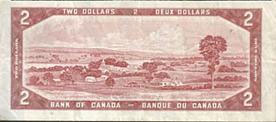 |
The back of a Canadian $2 bill with an image of Melbourne Township |
|
CLEVELAND TOWNSHIP |
Cleveland Township is believed to have borrowed its name from the Cleveland family which had been prominent in the community throughout the 18th Century. The original settlers of the town were locales of the British Isles who had arrived to clear the land along the St. Francis River. The arrival of the railway to the area in 1850 drew many new inhabitants, and caused the town to diversify into a booming economic center which included sawmills, processing plants and mines.
|
| ULVERTON |
| The town of Ulverton was originally settled at the beginning of the 19th century by American colonists, who were eventually joined by an influx of Scottish, Irish, and French Canadians later on in the century. While it remains uncertain, many believe that Ulverton’s name is a variation on the name of the town of Tilverton, a village close to Dublin Ireland, as well as the birthplace of one of the town’s original founders. Ulverton is now home to a variety of heritage buildings, making it one of the most picturesque villages in all of Québec. One of its famous landmarks is the Ulverton Woolen Mill which houses a still-functioning turbine and other machines representative of the early days of the textile industry in Canada. |
L'Association des Townshippers participe aux célébrations du 150e de l'Exposition de Richmond
Les villes de Canton Cleveland, Canton Melbourne, Ulverton et Richmond n'auraient pas pu mieux choisir une meilleure année pour accueillir la Journée des Townshippers au terrain d'exposition de Richmond. L'événement s'insérera dans les célébrations qui marquent la 150e année de l'Exposition de Richmond et qui se dérouleront pendant la semaine du 7 au 10 septembre, tout juste avant la Journée des Townshippers.
Plusieurs activités sont prévues pendant la durée de l'exposition afin de marquer cet important anniversaire. Selon Claudia Villemaire qui fait partie du Comité du 150e, l'Exposition présentera des tracteurs et machines agricoles antiques dont certains fonctionnent encore. Des prix spéciaux seront décernés dans les différentes catégories agricoles pour commémorer le 150e de l'Exposition.
Cette année, les visiteurs devraient aussi se rendre à la Tente anniversaire où ils pourront visionner un documentaire sur le passé de l'Exposition de Richmond. Le documentaire sera présenté en première le soir d'ouverture de l'exposition pendant un Vins et fromages. Seront présents à cette première Harry Lodge, président actuel de l'Exposition, auquel se joindront plusieurs anciens présidents de l'Exposition tous en costumes d'époque.
Ces activités spéciales, combinées avec les manèges, les spectacles, les animaux et les expositions auxquelles tous ont appris à s'attendre au cours des années, assureront de bons souvenirs de l'Exposition de Richmond de cette année. Bonne continuité pour les 150 prochaines années!
Un peu d'histoire…
Le premier concours d'animaux jugé, organisé par la Richmond Agricultural Society, s'est tenu le 24 septembre 1856 — il y a 150 ans cette année. Lord Aylmer de Melbourne, alors président de cette société, présidait le jury du concours. Au cours des années suivantes, de nouveaux bâtiments furent construits et le terrain fut aménagé afin de rehausser la qualité de l'Exposition annuelle.
Le 100e anniversaire de l'Exposition de Richmond fut célébré en août 1956 par un Salute to the Century Ceremony. À cette époque, plusieurs ont réalisé que l'exposition avait parcouru un long chemin depuis ses premières années, passant d'une activité sans bâtiment permanent qui présentait un petit concours auquel n'assistaient que quelques visiteurs à un événement qui attirait plusieurs familles pendant toute une fin de semaine.
En 1965, l'Exposition fut relocalisée à son site actuel, le long de la route 143 qui relie Richmond et Windsor, parce que plus approprié au genre d'événement que les organisateurs de l'exposition désiraient présenter. Le premier bâtiment construit sur le nouveau terrain d'exposition fut l'Aréna, construit entièrement par des bénévoles.
Le nouveau terrain d'exposition a connu le succès de nombreuses expositions au cours des 4 dernières décennies. À tous les ans, l'assistance augmente depuis 8 ans, tendance qui se maintiendra certainement cette année et pour de nombreuses autres années. Il n'est donc pas surprenant que, 150 ans plus tard, l'Exposition de Richmond se poursuit et se porte très bien!
| RICHMOND |
La ville de Richmond, ainsi nommée en l’honneur de Charles Gordon Lennox, Gouverneur général de l’Amérique Britanique du Nord et quatrième Duc de Richmond, a été colonisée, à l’origine, vers 1778, par des gens venus de la Nouvelle Angleterre, de Montréal et de la vallée du Richelieu. On s’accorde, aujourd’hui, à dire qu’il s’agit d’un des plus vieux village de la région des Cantons de l'Est. On se base, pour affirmer cela, sur de nombreux points de repère historiques trouvés dans la région. À une certaine époque, cette municipalité était un centre ferroviaire très actif placé sur le tracé de plusieurs voies ferrées dont celle du “Grand Trunk”. Richmond est encore aujourd’hui une localité pleine de dynamisme en grande partie à cause du fait qu’elle est située entre Sherbrooke et Drummondville.
|
| Le Canton de MELBOURNE |
On croit que le Canton de Melbourne tire son nom d’une ville de la Nouvelle Angleterre qui porte le même nom et qui serait située dans le Derbyshire ou le Hampshire. Colonisé à l’origine autour de 1799, les premiers colons venus à Melbourne étaient des gens de la Nouvelle Angleterre. Ils sont venus à Melbourne en quête de terres fertiles. Ces premiers pionniers ont alors érigé l’église presbytérienne St. Andrews, en 1820. L’église, encore debout aujourd’hui, est considérée, par plusieurs, comme un monument historique. Elle apparaissait au dos de tous les billets de banque du Canada de deux dollars qui furent imprimés entre 1954 et 1975..
|
|
L'endos d'un billet de banque canadien de deux dollars montrant une portion du Canton de Melbourne |
Le Canton de CLEVELAND |
On croit que le Canton de Cleveland tient son nom de la famille Cleveland qui a eu
son heure de gloire durant tout le 18ième siècle. Les premiers colons venaient des
Îles Britaniques et défrichèrent les rives de la Rivière St-François. L’arrivée du chemin de fer dans la région, en 1850, attira beaucoup de nouveaux habitants et contribua à transformer la ville en un centre économique florissant avec ses scieries, ses usines de transformation et ses mines.
|
| ULVERTON |
| La ville de Ulverton fut originellement colonisée au début du 19ième siècle par des colons américains. Ils furent joints, plus tard, au cours du siècle, par un afflux d’Écossais, d’Irlandais et de Canadiens français. Bien que cela demeure incertain, plusieurs croient que la ville tire son nom d’une réécriture du nom de la ville de Tilverton, un village situé près de Dublin, en Irlande. Tilverton était également le lieu de naissance d’un des fondateurs d’Ulverton. Le village comprend, aujourd’hui de nombreux édifices historiques qui en font l’un des endroits les plus pittoresques de tout le Québec. L’un de ses fameux points de repère est l’usine de laine d’Ulverton qui abrite une turbine toujours en état de fonctionnement ainsi que d’autres engins représentatifs des débuts de l’industrie textile au Québec. |
Top
|